How to Help a Kid Who “Doesn’t Care” Learn to Ski
A Parent Guide for Getting Your Kid to Ski
TL;DR
- Don’t try to “lecture” a kid into skiing better. Get them moving with short games and tiny wins.
- Behavior usually has a cause: cold, fear, hunger, embarrassment, or feeling forced.
- Give your child choices (two options you’re okay with) to reduce resistance.
- For lessons: tell the instructor what motivates your child, what scares them, and what usually triggers shutdown.
- Rewards work when you frame them as “finish strong” goals, not bribes mid-meltdown.
If your child acts bored, refuses to listen, or seems like they couldn’t care less about skiing… you’re not alone. In ski school, we see this all the time. And here’s the truth: “I don’t care” usually means something else. Your kid might be cold, anxious, overwhelmed, tired, hungry, or feeling forced.
This guide gives you practical tools to do two things:
- Help your child ski better yourself (without turning the day into a power struggle)
- Give ski instructors the right info and instructions so the lesson actually has a chance to work
Why Some Kids “Don’t Care” About Skiing
When a kid doesn’t listen, the worst move is assuming they’re lazy or stubborn. Most of the time, it’s one of these:
- Fear (fear often looks like apathy)
- Overwhelm (too much information, too long of a lesson, too big of a hill)
- Discomfort (cold hands, wet mittens, goggles fogging, boots hurting)
- Control issues (they feel forced—so they push back)
- Low trust (new instructor, new environment, social pressure)
- Boredom (not challenged, or the lesson is too “school-like”)
Once you guess the real reason, your strategy changes immediately.
Part 1: Tools for Parents to Help Your Child Ski Better
1. Fix the “basic comfort stuff” first
This sounds obvious, but it’s the #1 reason kids mentally check out. Before you push skill-building, do a quick check:
- Hands warm? (I’ve given my hand warmers to many kids because they didn’t have them)
- Boot buckles not cranked too tight?
- Neck warmer not itchy?
- Goggles clear / not fogging?
- Bathroom break handled?
- Snack + water in them?
If your kid is uncomfortable, you’re basically trying to teach math during a fire alarm.
2. Change your goal: tiny wins, not “perfect turns”
Instead of “Today you will learn to turn,” aim for:
- One good stop
- Two turns (one each direction)
- One full run with no crying/arguing
Skill grows fast once the day becomes positive again.
3. Give choices, but only choices you can live with
Kids who feel controlled will resist. Two good options beats one command:
- “Do you want to lead and I follow, or follow me like a shadow?”
- “One run on this slope, or one run over there?”
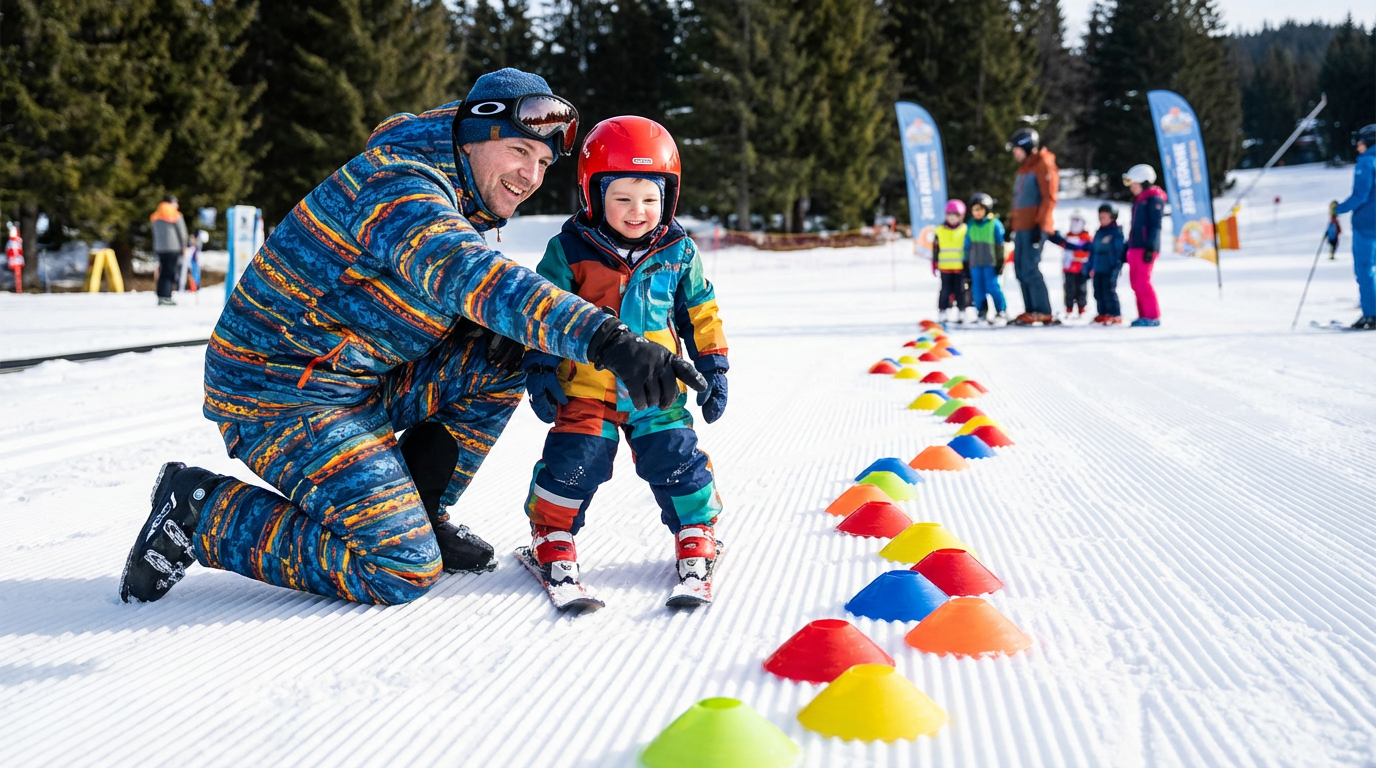
- “Do you want to do a cone game or a treasure hunt?”
4. Talk less, ski more
If you’re giving speeches on the hill, you’re losing them. Try this rhythm:
- Show it (no explanation)
- Let them try
- One sentence feedback
- Repeat
Kids learn way more from copying than from lectures.
5. Use “games that build skills by accident”
Follow-the-Leader (best all-purpose tool):
- “Copy my turns.”
- “Now you lead and I copy you.”
Statue Stops (teaches control):
- “Freeze like a statue next to that sign!”
- “Can you stop without spraying snow?”
Fun tasks (keeps them engaged):
- “On this run: touch your knees twice.”
- “On this run: quiet skis—make them whisper.”
- “On this run: biggest superhero stance stop.”
Points (kids will do ridiculous things for points):
- “1 point for stopping next to me.”
- “2 points if you do it smoothly.”
- “Winner chooses the next game.”
6. Keep everything balanced: practice both directions
A lot of kids will only turn one way if you let them. Make it a rule from day one:
- “Two turns left, two turns right.”
- “Left turn gets a point, right turn gets a point—tie game.”
7. Use terrain as your “assistant coach”
Sometimes your kid isn’t stubborn—they’re on terrain that’s too steep for their current skills. Move them to a slope where success is easy, then build from there.
- If they’re speeding up and panicking: go flatter
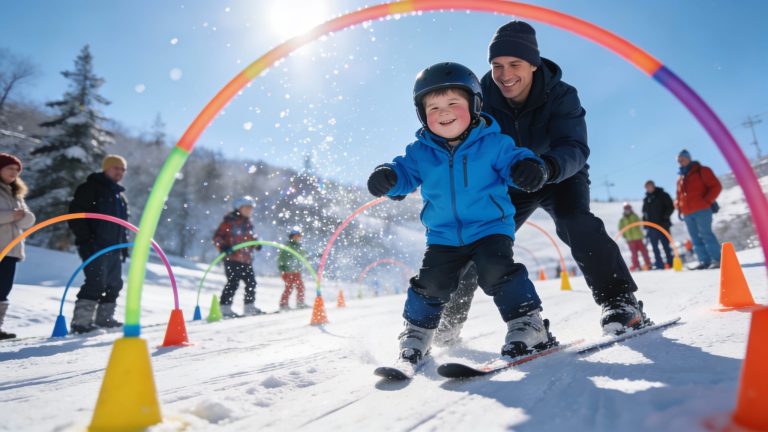
- If they’re bored: add a simple challenge (cone course, follow-the-leader, tiny jumps)
- If they’re overwhelmed: shorter laps and quick repeats
8. Use rewards the right way (so they don’t backfire)
Rewards work best when they’re framed as a finish-line goal, not a mid-tantrum negotiation.
- Good: “After your lesson, if you try your best and listen, we’ll do hot chocolate / arcade / choose dinner.”
- Not great: “If you stop screaming right now, you’ll get candy.” (This teaches them screaming works.)
Part 2: What to Tell the Ski Instructor (and Your Child) Before the Lesson
1. Tell the instructor what actually helps your kid
This is the most helpful “parent info” you can give ski school staff. Even one sentence is huge.
- Motivators: “They respond to games and being the leader.”
- Fears: “They’re nervous about speed / lifts / falling.”
- Triggers: “They shut down if they feel pressured or talked down to.”
- Comfort issues: “Boots tend to hurt, please check buckles.”
- Attention style: “Short instructions work best.”
2. Give the instructor permission to keep it simple
If your child isn’t ready for structured learning, it helps when parents explicitly support a “movement-first” approach. You can say:
- “If they’re not engaging, please switch to games and just get them skiing.”
- “Our main goal today is that they have a positive experience and stay moving.”
3. What to say to your child (quick script)
Keep it short and calm. Your goal is to reduce pressure and increase cooperation.
- “Your job is simple: listen to your instructor and keep moving.”
- “You don’t have to be perfect. Just try.”
- “When you’re done, we’re going to (reward).”
Then stop talking. Long speeches increase resistance.
4. Don’t “coach over the instructor” during the lesson
This is a big one. If your child sees you override the instructor, they’ll use you as an escape hatch.
- If you stay and watch: stay quiet and positive.
- If your child looks at you for rescue: a simple thumbs-up is better than stepping in.
5. If your kid is truly refusing: set a realistic win
Sometimes the best win is just getting them to participate at all. You can tell the instructor:
- “If they refuse, it’s okay to do a super short lap plan—tiny wins, lots of encouragement.”
- “If it turns into a power struggle, feel free to reset with a break and then try again.”
A Note From Me (Real Talk from Ski School)
Honestly, we sometimes get kids that will not listen. So what do we do?
We usually try a bunch of different approaches: games, choices, following, leading, tiny goals, terrain changes—anything we can think of to help learning happen. But if a kid is completely checked out, sometimes the best option is simply to ski with them, because time on snow still builds comfort and skill. And sometimes we’ll even sit with the kid if that’s all they’re willing to do.
We’d much rather be teaching, but we also understand that sometimes parents just need a sitter for a bit. No judgment. If that’s the day you’re having, we get it.
If you want to help us turn that lesson into something positive, the biggest things you can do are:
- Get your child comfortable (warmth, snacks, bathroom, boots)
- Set expectations: “listen, keep moving, try your best”
- Consider a finish-line reward if they listen and participate
FAQs About Getting Kids to Ski
Why won’t my child listen to the ski instructor?
It’s usually not “attitude” by itself. The most common causes are fear, cold/discomfort, overwhelm, hunger/tiredness, or feeling forced. Once the instructor identifies the real cause, they can pivot to a better approach.
Should I bribe my child to behave during a ski lesson?
A reward can work well if it’s framed as a finish-line goal (“After your lesson, if you try and listen…”). Avoid negotiating during a meltdown, because that can teach kids that refusing is a strategy to get what they want.
What should I tell the ski instructor before the lesson starts?
Tell them what motivates your child, what scares them, and what triggers shutdown. Even a 15-second summary helps the instructor choose the right approach quickly.
Is it still worth doing a lesson if my kid isn’t motivated?
Often, yes—because a good instructor can turn the day around with games and tiny wins. But also: some days are just “get comfortable on snow” days, and that still matters.
How can I help my child improve if they refuse instruction?
Keep it simple: focus on short, fun skiing laps, small goals (one stop, one turn each way), and lots of repetition on easy terrain. Progress follows participation.